
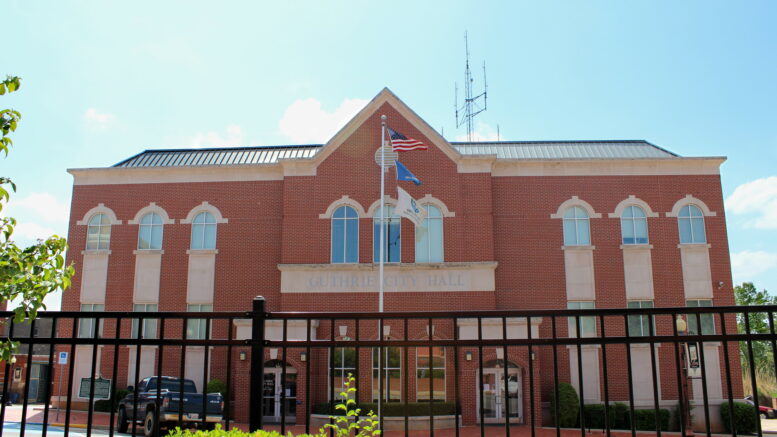

A discussion about a language change to a consent form for Guthrie’s Trap-Neuter-Return (TNR) program turned into an extended debate Tuesday night, as city officials, animal advocates, and council members clashed over property rights, legal liability, and the future of the city’s feral cat management efforts.
The consent form, given to residents who request help with feral animals on their property, required revision after city staff noted that some of the form’s language did not align with the ordinance previously passed by the council. The proposed update added one sentence meant to bring the document into compliance.
Related article: Guthrie council approves community cat management ordinance after lengthy debate
Mayor Adam Ropp explained that the change clarifies that the TNR consent form applies to residential property, ensuring consistency with the ordinance’s intent. However, the adjustment quickly sparked concerns over legal exposure and whether commercial property owners—such as schools and businesses—should be included.
The consent form at the center of the discussion had been previously approved by the council during its Sept. 16 meeting. That version included two options, with the second labeled “No Return to Property.”
In the revised form presented Tuesday night, the second option was updated to read “Residential Area – No Return to Property,” and an additional sentence was added: “This option is only applicable one time per residence.”
It was unclear during the council meeting how the cats would be returned to personal property without homeowners’ permission after the first request.
In a Sept. 10 article on Guthrie News Page, some residents shared their concerns about private property rights. Related article: Final draft ordinance for stray cats shows property owner consent clause, process of removing
“My biggest fear is that this ordinance would allow anyone – a caregiver as described – to come onto private property to return the cats,” stated one concerned resident who wished to remain anonymous. “We work hard to maintain our property, and the idea of someone coming onto it without permission, even for a well-intentioned reason, is unsettling.”
However, Ropp responded to the article by stating, “I just wanted to let you (Guthrie News Page) know that the TNR ordinance you have is an early draft that was only used as a starting point. It has gone through several revisions since then, and many of the core provisions are now quite different,” the mayor said to Guthrie News Page.
However, the question remains unclear how the animals will be returned to private property without the homeowner’s permission.
In addition to the new consent form, the form did not include language addressing commercial property, which raised questions among council members about potential legal exposure.
“I still think as legal counsel that we need a form that addresses commercial property as well as residential property,” City Attorney Billy Wheeler said in response to a question from Councilman Brian Bothroyd, who asked whether the new language might “open up ourselves (the City) to liability.”
Wheeler clarified that while the city can access city-owned property without consent, “all other property we’re going to have to have consent or legal cause to be on.” He added that limiting the form to residential use would not expose the city to additional liability, but suggested that a separate form be created for commercial property owners.
Bothroyd questioned whether calling all non-residential land “public property” could open the city up to lawsuits, using examples like Walmart or Braum’s to highlight the difference between public access and ownership. “They are privately held,” Bothroyd said. “You and I could be expelled from that property at the will of that owner.”
Local animal advocate Lisa New, founder of Helping Community Paws and Claws, spoke during public comment to urge the council to simplify the process and remove exemptions that allow for one-time removals of feral cats without return. New argued that those exceptions weaken Guthrie’s TNR program and could jeopardize future grant funding.
New added, “that sample release form that lets people do a buyout really can’t be on the ordinance because it makes the ordinance where we can not get funding.”
“The ordinance has become more complex than it should be,” New said. “That exemption weakens the ordinance. Most major organizations and foundations will only fund a true non-exempt TNR program.”
New also addressed misconceptions about TNR, explaining that cats are trapped, spayed or neutered, vaccinated, and then returned to the exact location they were found — not relocated or “dumped.” “TNR is not forcing people to take on responsibilities they didn’t ask for,” she said. “It’s simply preventing further litters and allowing communities to live more peacefully with cats.”
While several council members agreed the issue had become unnecessarily complicated, others stressed the importance of aligning the paperwork with city law before proceeding further. Bothroyd pushed for tabling the item until all parties, including an absent council member, could participate in finalizing the form language.
Ultimately, the council voted to approve the revision with a 4-2 vote, adding the word “residential” to the consent form to ensure consistency with the TNR ordinance, while leaving open the possibility of developing a separate form for commercial properties.
Ropp, who has spearheaded this ordinance, along with Vice Mayor Jeff Taylor, and council members Grant Aguirre and Menecca Gibbs, voted to approve. In contrast, Bothroyd and Councilman Tracy Williams voted against the measure.



Be the first to comment on "Council adjusts animal control consent form, but residential private property rules remain unclear"