
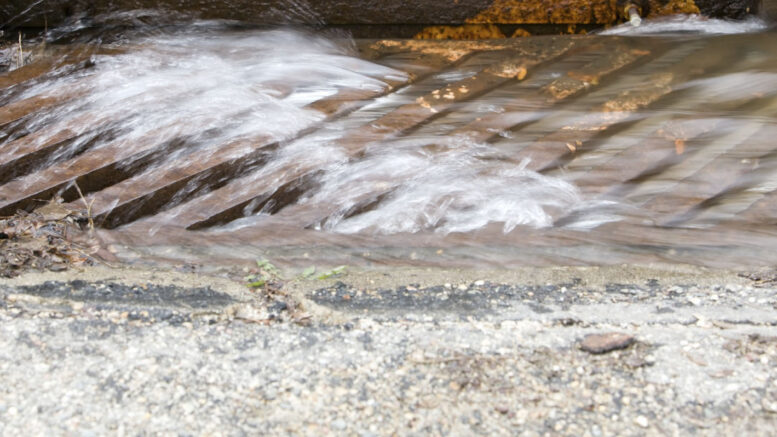

Logan County commissioners discussed a proposal to hire WSB Engineering to draft a federally compliant stormwater management plan for a designated urbanized portion of Logan County—an area covering approximately 22 square miles in the southern part of the county. The plan, which would cost the County $18,500, is the result of an eight-year standoff between the county and the Oklahoma Department of Environmental Quality (DEQ).
Years ago, the DEQ determined that a portion of unincorporated Logan County fell within a federally classified MS4 (Municipal Separate Storm Sewer System) area due to its high population density. This designation would bring the county under federal stormwater regulations, despite the County having no planning, zoning, or permitting authority to monitor or enforce development impacts.
Former Logan County Assistant District Attorney Lowell Bartow submitted extensive legal arguments against the designation, arguing the county lacked regulatory capacity. But after years of delays and occasional compliance threats, DEQ clarified that the county must still meet minimum requirements under federal law.
“Lowell had done a lot of research and submitted legal opinion on our behalf,” Logan County Clerk Troy Cole said to the commissioners. It was Bartow’s opinion, at the time, that this was a federal regulation and the county was going to need to comply.
“We put up a good fight, but we’re having to kind of give in,” Cole said.
Cole, District 1 Commissioner Mark Sharpton, and Emergency Manager Steven Haga recently met with DEQ representatives to seek a low-burden path to compliance. The DEQ acknowledged the county’s lack of enforcement ability and agreed to allow a minimum-level approach focused on public education and reporting rather than active enforcement.
The proposed plan would be created by WSB Engineering, a stormwater specialist already working with similar counties in Oklahoma. The plan would include simple measures such as public notices on the county website, informational social media posts, and training employees—especially law enforcement—to report any potential violations to DEQ under a “see something, say something” model.
“It’s trying to find the happy balance of what we can do and keep them (DEQ) somewhat happy,” Cole said.
The original estimate for this compliance effort was over $35,000, but negotiations scaled it back to $18,500. The two-year plan would allow county staff time to learn how to maintain compliance internally after the contract ends.
“I don’t work for DEQ, and they don’t tell me what to do,” District 3 Commissioner Monty Piearcy said. “I mean, DEQ wants us to do their job. If DEQ wants us to do their job, we don’t need DEQ. If DEQ wants to pay the $18,000, I’m good with that.”
Cole reminded the board that this proposal falls under a federal regulation that is passed on to the state, and the county falls under the state as a political subdivision.
“I wasn’t part of it before, but I can tell you our meeting with DEQ, they weren’t threatening,” Sharpton told his fellow commissioners. “They were let’s work together to figure out what we can do so you’re in compliance and we’re satisfied or we’re in compliance. Now, that has nothing to do with whether you’re for it or against it. I just want you to know they were very professional.”
Piearcy remains skeptical of the cost, questioning why the county couldn’t draft its plan. However, Cole clarified that federal standards must be met.
“I think it gets us off the hook and gets them off our back,” Sharpton said.
The item was not approved at the meeting, with commissioners expressing interest in gathering more information and potentially arranging a joint meeting with DEQ representatives before moving forward.
If the plan had been approved, the plan would have helped the county avoid steep noncompliance penalties—potentially $10,000 per day—and resolve years of regulatory limbo between the county and the state.
The video below is from April 2017, when the BOCC considered the stormwater issue.



Be the first to comment on "Years of pushback from DEQ to Logan County for stormwater compliance continues"